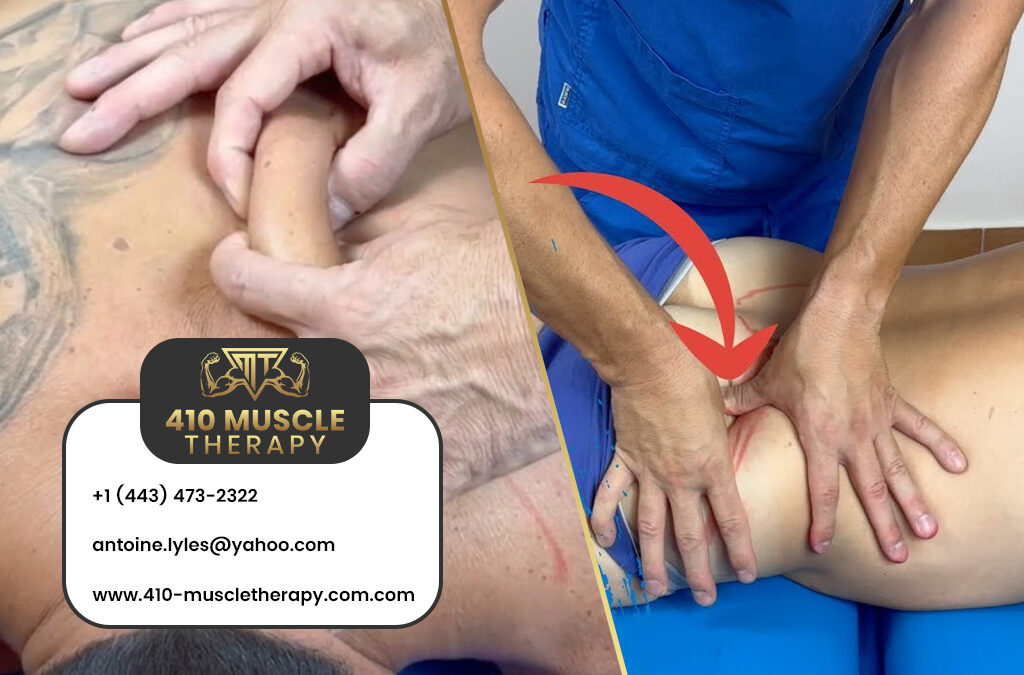
When it comes to relieving muscle pain, improving mobility, and restoring overall wellness, two techniques are often recommended: trigger point therapy Maryland and deep tissue massage.
At first glance, they may seem similar, both involve pressure, both target muscles, and both aim to reduce pain. But if you’ve ever tried one and didn’t get the results you expected, the reason could be simple: you chose the wrong therapy for your type of pain.
In this guide, we’ll break down the real difference between trigger point therapy and deep tissue massage, the science behind how they work, and how to choose the right one for your body.
What Is Deep Tissue Massage?
Deep tissue massage is a therapeutic technique designed to target the deeper layers of muscles and connective tissue (fascia). Unlike a relaxation massage (like Swedish massage), it uses slow, deliberate strokes and sustained pressure to release chronic tension.
Studies on chronic low-back and myofascial pain indicate that deep tissue massage can reduce pain and improve mobility, particularly when combined with exercise or stretching
This therapy focuses on breaking down adhesions. Adhesions are bands of painful, rigid tissue that can form in muscles, tendons, and ligaments. They act like “glue” that blocks circulation and causes pain and limited movement.
If you’re curious about what actually happens during a session, this guide What happens during a deep tissue massage session? ↗ will explain to you in detail. So, make sure to check it out.
How It Works
- Friction and Pressure: The therapist uses their elbows, forearms, or knuckles to apply pressure across the grain of the muscle.
- Fascial Release: It targets the fascia (the protective sheath around muscles) to ensure it moves freely.
- Oxygenation: By breaking down adhesions, it allows fresh blood and oxygen to reach previously “starved” muscle tissue.
What Is Trigger Point Therapy?
Trigger point therapy is a more surgical, focused approach. It targets specific tight knots in muscles, hyper-irritable spots that are painful when pressed.
The unique characteristic of a trigger point is referred pain. This means a knot in your neck might be the secret reason you have a headache, or a knot in your glute might be causing pain in your calf.
Learn more about How trigger points develop ↗ and How they relate to chronic pain ↗ in detail.
The Science of Muscle Knots: Why Do They Form?
Before choosing a therapy, it helps to understand why your muscles are acting up. Evidence-based approaches to myofascial trigger points show that targeted manual therapy can reduce pain by around one-third and improve activity, sleep, and quality of life in many patients.
Muscle knots (trigger points) and general tension usually result from:
- Repetitive Micro-trauma: Doing the same movement over and over (like typing or lifting).
- Postural Stress: Sitting at a desk for 8 hours a day creates “adaptive shortening” of certain muscles.
- Dehydration and Nutrition: Without enough water or electrolytes like magnesium, muscle fibers can “stick” together.
- Emotional Stress: When you are stressed, your body holds tension in the jaw, neck, and shoulders.
Trigger Point Therapy vs Deep Tissue Massage: Key Differences
Here is a summarised difference between Trigger Point Therapy vs Deep Tissue Massage for you to know the key difference between the two.
|
Factor |
Deep Tissue Massage |
Trigger Point Therapy |
|
Primary Focus |
Large muscle areas and layers |
Specific hyper-irritable spots (knots) |
|
Technique |
Gliding, friction, kneading |
Sustained compression (Ischemic pressure) |
|
Sensation |
“Good hurt” those spreads |
Intense, localized, or radiating |
|
Duration |
Usually, a full 60-90 min session |
Can be a 15-min focused “blast” |
|
Best For |
Overall stiffness/post-gym soreness |
Chronic radiating pain/Specific injury |
The “Pain Mapping” Approach: A Smarter Way to Choose
Most people choose a massage based on the name, but you should choose based on the nature of your pain.
1. Is the pain “Point-Specific”?
If you can put one finger on the exact spot that hurts, you likely have a trigger point. Deep tissue massage might “miss” the source by spreading the pressure too thin.
2. Is the pain “Dull and Aching”?
If your whole back feels like a heavy block of wood, that is generalized tension. Deep tissue massage is the better tool for “softening” that entire area.
3. Is the pain “Traveling”?
If pressing your shoulder makes you feel a zing in your arm, that is a classic trigger point. You need targeted release to stop the signal.
Deep Dive: Conditions Treated by Each Therapy
When to Choose Deep Tissue Massage
Learn When deep tissue massage is the best option for chronic pain ↗. Some of the events are described as under.
- Fibromyalgia: While pressure must be adjusted, deep tissue can help manage widespread discomfort.
- Athletic Recovery: After a marathon or heavy lifting cycle, deep tissue clears out metabolic waste.
- Chronic Posture Issues: If you have “rounded shoulders” from phone use, deep tissue helps lengthen the tight chest muscles.
When to Choose Trigger Point Therapy
Prefer Point Therapy after:
- Sciatica: Often, pain down the leg is actually caused by a trigger point in the piriformis muscle.
- Tension Headaches: Usually caused by trigger points in the upper trapezius or suboccipital muscles.
- Tennis Elbow: Caused by knots in the forearm extensors.
How Do These Compare to Other Techniques?
It’s easy to get lost in the sea of massage terminology. Here is how you should compare massage services to opt better one for you.
While Relaxation (Swedish) massage stays on the surface, and Myofascial Release focuses on the “skin” of the muscle, Deep Tissue and Trigger Point are the “heavy hitters” that go inside the muscle belly.
What to Expect: The “Soreness Factor”
One common question is: Will it hurt?
- Deep Tissue: You will feel a strong, spreading pressure. It should feel like a “productive” pain.
- Trigger Point: This can be more uncomfortable. When the therapist hits the knot, your body may have a “twitch response.” This is actually a good sign,it means the muscle is releasing.
Pro Tip: In both cases, if the pain is so high that you are holding your breath or tensing up, tell your therapist. If you tense up, the therapy won’t work.
Post-Treatment Care: How to Sustain the Results
Getting the treatment is only 50% of the battle. The other 50% is what you do in the next 24 hours.
- Hydrate: Water helps flush out the toxins released from the muscle tissues.
- Gentle Movement: Don’t go straight to the gym. Take a light walk to keep the blood flowing.
- Heat Therapy: A warm Epsom salt bath can help soothe the “post-massage soreness” that often feels like a workout ache.
- Listen to Your Body: You might feel tired or “emotional” after a deep release. This is a normal neurological response to releasing long-held physical tension.
You can also learn Top benefits of massage therapy for pain relief and wellness ↗ in detail. This will help you to pinpoint the exact treatment you want.
Can I Do These at Home?
While a professional therapist is always best for complex issues, you can manage minor pain yourself:
- For Deep Tissue: Use a high-quality foam roller to apply broad pressure to the quads or back.
- For Trigger Points: Use a tennis ball or lacrosse ball. Place it between your back and a wall, lean into the knot, and hold for 30–60 seconds until the pain “melts.”
Summary
Both massages are done for different purposes as they target various parts and muscles. Hence there is no clear winner between the two. The purpose was to make people self-aware about choosing the right tool. In this case: Choose Deep Tissue Massage if you want to improve your overall mobility, posture, and systemic tension. It is a “reset button” for your entire musculoskeletal system. Meanwhile, choose Trigger Point Therapy, Maryland if you have a specific “problem area” that is causing sharp or radiating pain. It is a “surgical strike” against chronic knots. The most effective treatment plans often involve a hybrid approach: using deep tissue to warm up and soften the body, followed by trigger point work to eliminate the stubborn “source” of the pain.
FAQs
1. Is trigger point therapy more painful than deep tissue massage?
Yes, usually. Because it targets a very small, sensitive area, the intensity is higher. However, the relief is often more immediate.
2. How often should I get a deep tissue massage?
For chronic issues, once every 2–4 weeks is standard. For maintenance, once a month is perfect.
3. Why do I feel sore the next day?
When adhesions are broken down, it creates a small amount of localized inflammation (similar to exercise). This is part of the healing process.
4. Can these therapies help with stress?
Absolutely. Physical tension and mental stress are a loop. By breaking the physical tension, you send a signal to your nervous system that it is safe to relax.
5. Which is better for an old injury?
If the injury has left you with “scar tissue” or limited range of motion, a combination of both is best. Deep tissue softens the scar tissue, and trigger point releases the compensatory knots.
6.Where Can I get the best Deep Tissue Therapy Massage services in Maryland?
You can get the best Deep Tissue Therapy Massage services at near Maryland at 410 Muscle Therapy.